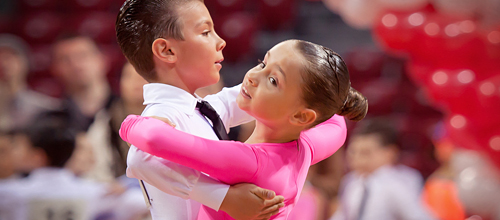
In the beginning of the 20th century dances emerge and form in the way we know them today, namely competitive dances or later called dance sport. They are divided into two main groups – Standard and Latin American, five dances in each.
[expand title=”Read more”]
Standard Dances:
English (slow) waltz – music proportions in ¾, tempo 28-30 beats per minute. It was performed for the first time in 1918. It originates from the American “boston”.
Tango – music proportions 4/4, moderately fast tempo 30-32 beats per minute. Origin – Argentina. In 1907. Paris held the first official contest tango.
Viennese waltz – musical size 3/4, moderately fast pace – 58-60 beats per minute. In 1813 it was denied as a dance, but it was impossible to stop its spread.
Foxtrot / Slowfox / – music proportions 4/4, the tempo is moderate 29-30 beats per minute. Origin – America, created by Harry Fox in 1910. One of the most popular dances.
Quickstep – music proportions 4/4, tempo fast – 50-52 beats per minute. American dance that appeared in Europe in the early 20s.
Latin American dances:
Samba – music proportions 2/4, moderately fast tempo 50-52 beats per minute. Homeland – Brazil. Fast paced dance with pulsing rhythm.
Cha-cha – music proportions 4/4, moderately fast pace – 30-32 beats per minute. They were created based on Cuban dances in 1953 in Havana – Cuba.
Rumba – music proportions 4/4, slow pace – 24-26 beats per minute. It is danced on a special kind of slow music called “rumba bolero.” It originates from Cuba.
PASODOBLE – music proportions 2/4, moderately fast pace – 58-60 beats per minute. The origin of the dance – Spain. It was performed during fiestas. It was first spread in Latin America, and later in Europe, but as competition dance.
Jive – music proportions 4/4, tempo fast – 40-44 beats per minute. It was known as “Boogie” in 1938, as “jitterbug” in 1940, as “bimbon” in 1945 – but it always had the same steps and movements. It gets the name “Jive” from the English. A decisive turning point in the performance and the movements of the Jive dance come between 1955 and 1957 with the debut of the “rock and roll” music.
The modern tendencies in the development of ballroom dancing are mainly in the direction of athleticism and dynamics. Despite the closeness to extreme sports, there is something very attractive, beautiful and enduring in them.
The social Latin dances, that are taught in courses for children: salsa, merengue, cha-cha.